 Dutch website
felix culpa
30-09-2011 - Posted by Andre Piet
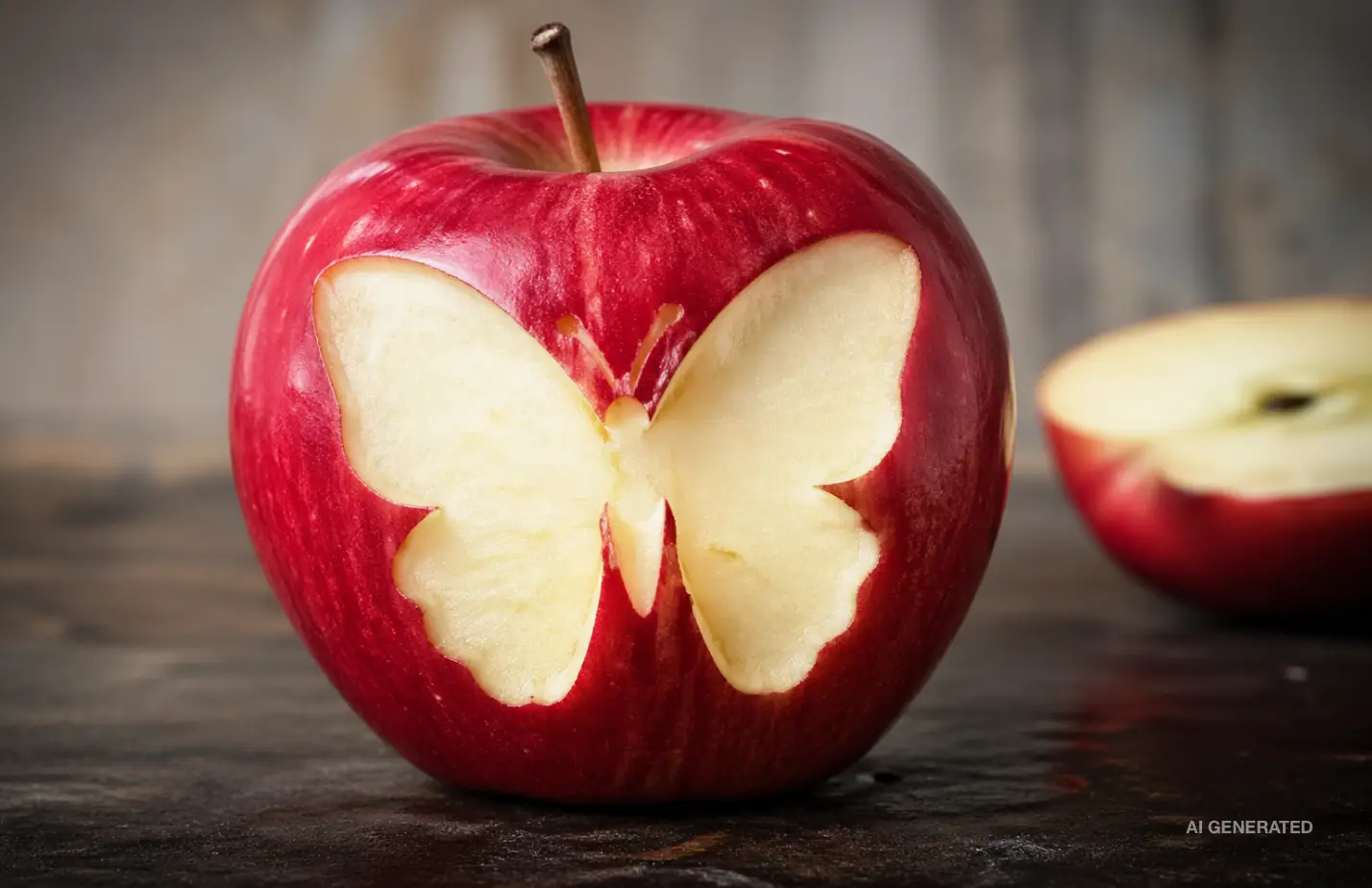
I received an email in connection with the Jewish New Year (September 29, 2011, 1 Thisri), which included the photo shown above. It is a beautiful illustration: a butterfly, symbolizing new life, cut out of an apple.
You know, of course, the much-maligned apple. In this case, however, maligned is an interesting word, because it is derived from the Latin word for “evil,” malus. Yet this same Latin word can also mean apple. As a result, through Church Latin, “the forbidden fruit” easily came to be identified as an apple. After all, Adam and Eve ate from “the tree of the knowledge of good and evil” (malus = apple).
This association is based on a misunderstanding, but it was easily adopted by ordinary church people, who scarcely knew any Latin.
The symbolism in the picture above is even more striking than its creator likely realized. By eating of “the forbidden fruit,” humanity came to know evil experimentally. But that is not all. In the first place, it also came to know good. Knowledge of good cannot be obtained in isolation. We come to know good only in contrast to evil.
It all began in the Garden. Hardly had the first humans eaten of “the forbidden fruit” when they heard Him, who came looking for them, asking:
Adam, where are you?
Soon afterward, they received the promise of the victory of “the seed of the woman.” Then, and not before, the light of God’s grace and love began to shine.
For good reason, people long ago spoke of felix culpa. This is another Latin expression, meaning:
Happy fault.
God arranged for evil to occur in order to bring about the reality of the good He intended. Although many objectionable conclusions are drawn from this truth (Rom. 3:8), it nevertheless remains true:
With God, nothing ever goes amiss.
Translation: Peter Feddema
Share: