 Dutch website
Climate Denial?
04-07-2026 - Posted by Geert-Jan“Climate denial.” What a bizarre term, when you think about it. Who denies the climate? No one, surely? And who denies that the climate changes? The climate has never done anything else. The real questions, therefore, lie elsewhere. To what extent is climate change caused by human activity? How reliable are projections extending many decades into the future? And perhaps even more importantly: to what extent is humanity capable of controlling the climate through political measures at all?
In the July 2 edition of Nederlands Dagblad, David Onnekink, endowed professor of Christian ecological thought, wrote an article presenting “three reasons for Christians to take climate change seriously.” He is concerned about “climate denial” among Christians and gives three reasons not to go along with it: reliability, concern for others, and theology.
Onnekink begins with a Facebook post claiming that volcanoes emit far more CO₂ than cars do. According to fact-checkers, that is incorrect. That may well be so. False arguments should not be used. But what does that prove about the questions actually under discussion? One faulty Facebook post does not make its author the spokesperson for everyone who asks critical questions about climate policy. Yet that is precisely the atmosphere created by a term such as “climate denial”: anyone who does not go along with the prevailing narrative is grouped together with people who deny facts.
Humanity as Savior
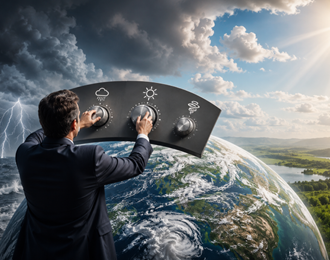
In my view, the greatest misunderstanding lies even deeper. It is the belief that we human beings can control the course of this world. That governments can regulate Earth’s temperature through taxes, prohibitions, subsidies, and international agreements. That we can halt global warming and thereby save “the planet.”
Remarkably, the climate prophets leave God entirely out of account. Humanity is elevated to a position that does not belong to it: humanity supposedly disrupted the climate, determines the course of the world, and can then also save the Earth. In this narrative, the future of the Earth lies entirely in human hands.
And that is precisely where things become bitterly ironic from a biblical perspective. For the judgments of which Scripture speaks come upon a world that does not take God into account and in which humanity exalts itself. People seek to save the world from precisely the same underlying attitude against which God’s judgments are directed: humanity at the helm and the future in human hands.
Responsible care for our environment is a good thing. That is not in dispute here. But it is entirely different from the presumption that humanity can control the global climate.
This Earth Has a Future
Anyone familiar with Scripture knows that the future of this world does not lie in human hands. The Bible explicitly tells us what still awaits this Earth. Ahead of us lies a time when Christ will reign for a thousand years and Satan will be bound so that he can no longer deceive the nations (Rev. 20:1–6). For that reason alone, scenarios in which the Earth will soon perish because of climate change are completely unbiblical.
This Earth has a future. Not because humanity saves it, but because God carries out His counsel. The times and eras are fixed under His jurisdiction. Humanity neither prevents God’s judgments nor brings about the coming kingdom.
That does not mean, incidentally, that the Bible paints a rosy picture of the immediate future. Quite the contrary. Before the Messianic kingdom arrives, immense judgments will sweep over this world. But in those judgments too, it is God Who acts. That is precisely what is entirely absent from the modern climate narrative.
Scorching Heat
Remarkably enough, Onnekink himself appeals to Revelation 16:9. There, he writes, “scorching heat is the result of sin.” And scorching heat is indeed mentioned there. When the fourth bowl is poured out, the sun is permitted to scorch humanity with fire.
But this is not a description of climate change caused by CO₂ emissions, nor is it a warning against overconsumption. It is a judgment from God. This judgment is, of course, connected with human sin. Onnekink is correct about that. But precisely for that reason, it is misleading to cite this passage of Scripture in an argument about human-caused climate change.
The scorching heat of Revelation 16 does not come upon the world because governments failed to adopt sufficient climate measures. It comes because God judges. And humanity’s response is telling: they “blaspheme the name of God, Who has the jurisdiction over these calamities, and they do not repent, to give Him glory” (Rev. 16:9). This is not about humanity failing to reduce its emissions sufficiently, but about humanity refusing to acknowledge God.
The idea that political measures could prevent what God has announced in His Word is therefore utterly bizarre. As though climate conferences and CO₂ taxes could avert the judgments of Revelation.
No Destruction
Scripture presents a completely different picture from the modern climate narrative. In that narrative, humanity is both the great culprit and the potential savior. Humanity supposedly disrupted the climate but can still preserve the world – provided that the right political decisions are made in time. The one who caused the problem thus also becomes the one from whom salvation must come.
Yes, judgments are coming. Judgments far more severe than most climate prophets could imagine. Revelation foretells that one-third of the vegetation will be burned and one-third of the life in the sea will die (Rev. 8:7–9). And the worst will still be yet to come… No political measure will be able to prevent what God has announced.
But this Earth will not perish. After the judgments, the Messiah takes control. From Jerusalem, law will go forth throughout the world. This is precisely where the great miscalculation of modern climate thinking lies. It does not take God into account, while attributing to humanity a power that does not belong to it. Humanity supposedly disrupted the Earth and must now save it as well. But it is precisely upon a world that leaves God out of account and places humanity on the throne that the judgments of Revelation will come.
Share: