 Dutch website
Does the Jubilee Cycle Last 49 Years?
01-03-2025 - Posted by Andre PietOver the past ten years, many studies have been published on the GB website pointing to the magnificent significance of the Jubilee. Not least in connection with biblical chronology. Remarkable milestones in biblical history repeatedly coincide with Jubilee years. Essential to this approach, of course, is the fact that a Jubilee year is the fiftieth year. Leviticus 25 says:
8 “And thou hast numbered to thee seven sabbaths of years, seven times seven years, and the days of the seven sabbaths of years have been to thee nine and forty years, 9 and thou hast caused a trumpet of shouting to pass over in the seventh month, in the tenth of the month; in the day of atonements ye do cause a trumpet to pass over through all your land, 10 and ye have sanctified the fiftieth year, and proclaimed liberty in the land to all its inhabitants; it is a jubilee to you…” (YLT)
It should be clear that the Jubilee follows a period of forty-nine (7×7) years. Our word “jubilee” is also derived, indirectly, from this biblical concept. Biblically speaking, a jubilee is by definition a golden jubilee: the fiftieth year.
The 49th year?
Clear as the above may seem, there has long been considerable discussion about the length of a Jubilee cycle. A well-known interpretation holds that the Jubilee is not an inserted year, but serves as the first year of the new series of sabbatical-year cycles. In that case, only the first Jubilee would be a fiftieth year, while all subsequent Jubilees would occur every forty-nine years.
The argument for this reasoning is drawn from Leviticus 23. There Pentecost is spoken of as the fiftieth day after seven weeks/Sabbaths (Lev. 23:15,16). Since the fiftieth day is also the first day of a new week, it is concluded that the Jubilee year likewise serves as the first year of a new sabbatical-year cycle.
But the parallel with Pentecost does not hold. The cycle of seven-day weeks runs continuously, and Pentecost does not constitute a separate week within that cycle. In Leviticus 25, by contrast, seven sabbaths of years are first counted, totaling forty-nine years, after which the fiftieth year is consecrated. Nowhere does the text say that this fiftieth year is also to be counted as the first year of a new sabbatical-year cycle. Every fiftieth year is a Jubilee, whereas not every fiftieth day is Pentecost.
A set-apart year
A golden jubilee is the fiftieth year, after which a new count of fifty years begins. Thus, two golden jubilees together span exactly one hundred years. The same applies to the biblical Jubilee.
The fiftieth year is explicitly consecrated, that is, set apart (Lev. 25:10). It follows the seven sabbatical-year cycles totaling forty-nine years and thus stands apart from them. To nevertheless count this set-apart year as the first year of the next series of seven sabbatical-year cycles undermines precisely that set-apart character: it would no longer stand outside the series, but would form part of it. The text gives no indication whatsoever of such a double counting.
Moreover, if the Jubilee year were also the first year of a new sabbatical-year cycle, another problem would arise. The Jubilee itself is a year of rest in which no sowing takes place (Lev. 25:11). If that same year also counts as year 1 of the new sabbatical-year cycle, only five years of sowing and harvesting remain before the seventh year—the next sabbatical year—arrives. This conflicts with what Leviticus 25 says:
3 “Six years thou dost sow thy field, and six years thou dost prune thy vineyard, and hast gathered its increase, 4 and in the seventh year is a sabbath of rest to the land…” (YLT)
The conclusion must be that the Jubilee is by definition the fiftieth year and always follows AFTER seven times seven years. Then a new series of sabbatical-year cycles begins: six years of sowing and harvesting, followed by the seventh year as a sabbatical year.
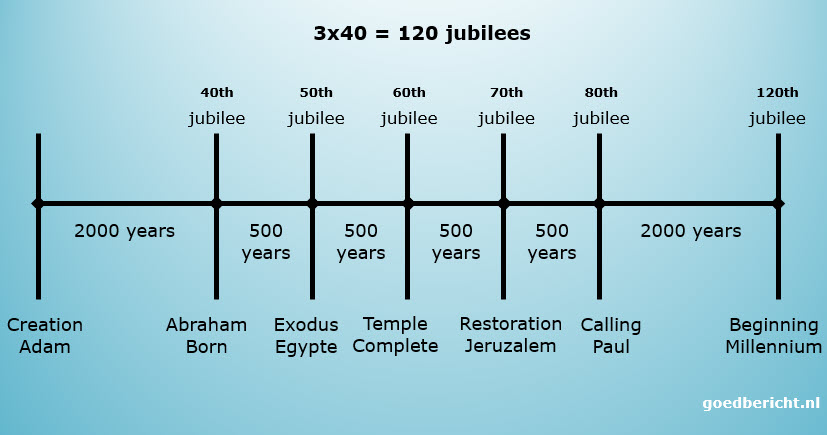
Only on this basis do we arrive at a biblical timeline whose milestones synchronize perfectly with Jubilee years. That in itself is not proof of how Leviticus 25 should be understood, but it certainly provides magnificent confirmation!
Share: