 Dutch website
Is an Eon Eternity?
26-08-2015 - Posted by Andre PietBy far the majority of Bible translations use the word “eternity.” As far as the “New Testament” is concerned, this is the rendering of the Greek word aion. At least, that is true in some renderings, because aion is also often translated as “age.” This is extraordinarily confusing, because an “eternity” has neither beginning nor end, whereas an “age” does. How can one word have two mutually exclusive meanings?
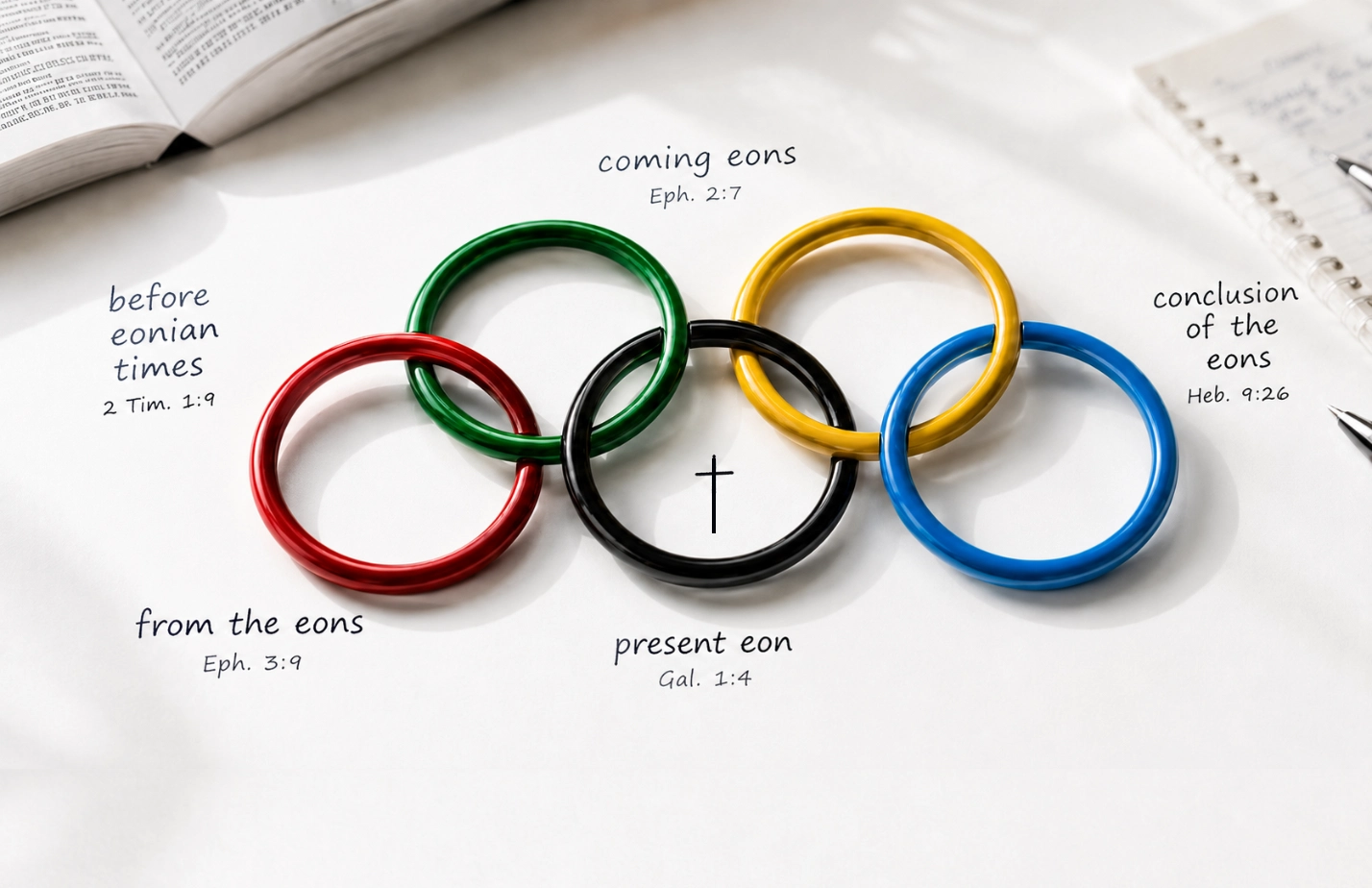
Read the following passages of Scripture in which “eons” are mentioned, and see how absurd “eternity” would be as the translation:
- before the eons; 1 Corinthians 2:7
- makes the eons; Hebrews 1:2
- the conclusion of the eon; Matthew 28:20
- the coming eon; Luke 18:30
- the oncoming eons; Ephesians 2:7
- from the eons; Ephesians 3:9
- the eons of the eons; Revelation 11:15
- the conclusion of the eons; Hebrews 9:26
- before times eonian; 2 Timothy 1:9
Conclusion: eons explicitly have a beginning and an end, and therefore “eternity” is NOT a correct translation.
Eternal, Yet Not Endless…
an eternal covenant; Leviticus 24:8
and yet it is replaced by a new covenant; Jeremiah 31:31–34
the earth stands forever; Ecclesiastes 1:4
and yet it passes away; Matthew 24:35
the priesthood of Aaron is forever; Exodus 40:15
and yet not endless; Revelation 21:22
a slave forever; Exodus 21:6
and yet it comes to an end…
eternal reproach upon Israel; Jeremiah 23:40; Jeremiah 25:9
and yet one day her reproach will no longer be remembered; Isaiah 54:4-5
eternal desolation over Jerusalem; Isaiah 32:14
and yet… until the Spirit is poured out upon them from on high; Isaiah 32:15
eternal fire upon the cities around Sodom; Jude 1:7
and yet these cities will one day return to their former state; Ezekiel 16:55
eternal sleep; Jeremiah 51:39, 57
and yet all who are in the tombs will awaken; John 5:28
Christ reigns forever; Revelation 11:15
and yet “until”; 1 Corinthians 15:24–25
Conclusion: the Dutch word eeuwig (“eternal”) has nothing to do with eeuwigheid (“eternity”), but with eeuw (“age”). Consistently and without exception.
A Few Reference Works Weigh In
The Winkler Prins Encyclopedia (1950, vol. 7, p. 797) says:
Aion, eon, does not mean endless duration, but a period of time.
The Biblical Encyclopedia (p. 239) says concerning “eternity”:
Except when used of God, it is usually intended temporarily, as a very long period of time.
(…)
The Hebrew olam, translated as “eternity” in the Old Testament, is related to a verb meaning “to conceal.” It therefore denotes something that is—or still is—concealed in the past or future… It thus has the meaning of a very long period of time.
In Korte Verklaring (on Ecclesiastes 1:4), Professor Aalders writes:
Moreover, one should bear in mind that the word “eternal” in Hebrew generally does not have the meaning we usually attach to it. It merely expresses a long period of time…
Share: