 Dutch website
Baptized in the Name of the Father, the Son, and the Holy Spirit?
Go therefore, make all the nations My disciples and baptize them in the name of the Father and of the Son and of the Holy Spirit, and teach them to observe all that I have commanded you.
Matthew 28:19 (NBG51)
corrupt text?
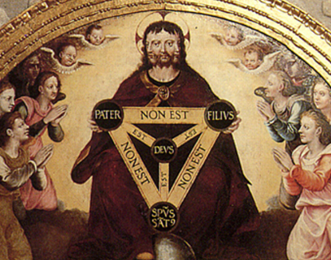
Much has been made throughout church history of the formulation in the verse above. If Jesus meant to give a baptismal formula with these words, then the question inevitably arises why we never read that His disciples actually used this formulation.
It is remarkable that among theologians the opinion is fairly widespread that the formulation of Matthew 28:19 would not be original, but was adapted for liturgical reasons to the confession of the Council of Nicaea. The three great manuscripts — Alexandrinus, Sinaiticus, and Vaticanus — which date from the time of this council, would thereby have been influenced and projected their theology into the translation.
no doctrine of the Trinity
If, however, we proceed from the reliability of the three great manuscripts, then we must look for the explanation in a very different direction. Granted, the formulation in Matthew 28:19 calls to mind the formulation of the doctrine of the Trinity. But it is nothing more than association. Just consider it. Matthew 28:19 does not mention the word Trinity, nor does it refer to it in content. It does not claim that “the Son” would be God Himself. Nor does it teach that the holy Spirit would be a separate person within the Godhead. In other words: the formulation in Matthew 28:19 is no proof, and not even an argument, for the doctrine of the Trinity.
no water baptism
When, toward the end of this aeon (Matt. 28:20), the Evangel of the Kingdom will be proclaimed by Israel, then all the nations will be immersed in pure teaching concerning the name of (God) the Father. There is no need here to think of a baptism in water (cf. Mark 10:38; 1 Cor. 10:2); the subject here is teaching. Nowhere in the New Testament do we read of a commission in which non-Israelites would have to be baptized in water. Water baptism is an Israelite ritual (John 1:31; Heb. 6:2), in which gojim at most receive a share as “strangers within the gates” (Acts 10:47).
This explanation of baptism is confirmed in the variants of this text that are older than the three great manuscripts mentioned earlier. Thus the church father Eusebius (260–339 AD) cites this verse seventeen times in his writings and reads:
“Go and make all nations disciples in My Name and teach them to observe what I have commanded you…”.
In this reading there is mention of instruction and learning, but the thought of water baptism is absent.
the last generation
When, in the last generation of this aeon, “the great commission” will be successfully fulfilled by Israel (Matt. 24:14; Acts 15:16, 17), then all nations will be taught — literally, discipled — in the name of the Father. But also in teaching concerning the Son of God and God’s holy Spirit.
Share: