 Dutch website
When Did Cyrus Give the Command?
26-09-2026 - Posted by Geert-JanThe first year of Cyrus is generally dated around 538/537 BC. This is regarded so strongly as an established fact that hardly a question mark is placed beside it. Yet Biblical chronology arrives at a very different year: approximately 467 BC. A difference of more than seventy years. And that difference is directly relevant to Daniel 9, for there the beginning of the seventy year-weeks is connected with “the going forth of the word to restore and to build Jerusalem” (Dan. 9:25).
Cyrus as a fixed point
That Cyrus comes into view here is obvious. Long before he appeared on the scene, Isaiah already mentions him by name. YAHWEH calls him “My shepherd” and says of him that he will say of Jerusalem that she shall be built, and of the temple that its foundation shall be laid (Isa. 44:28). In the next chapter we again read concerning Cyrus: “He shall build My city, and My exiles shall he release” (Isa. 45:13).
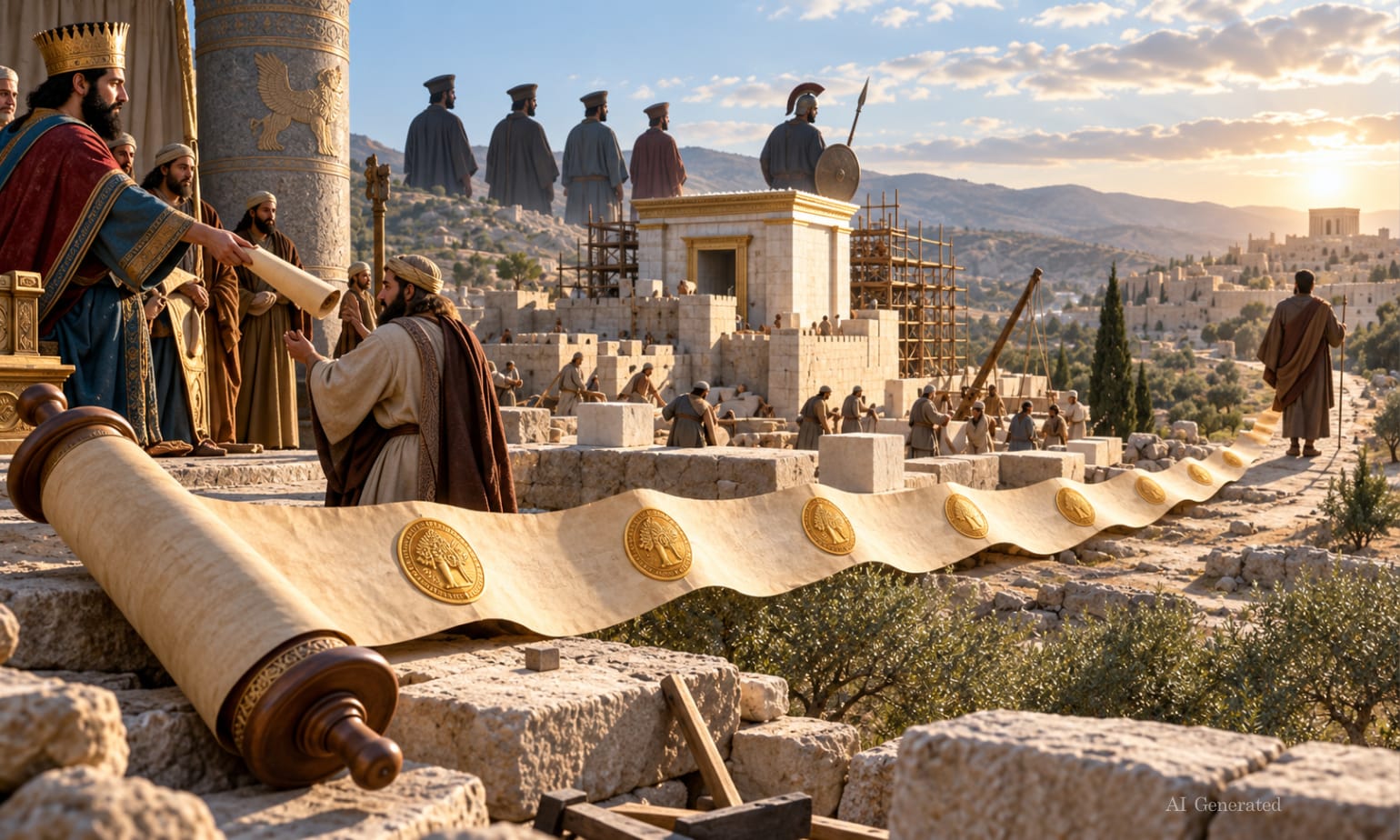
When Cyrus actually appears, Ezra therefore begins with the statement that YAHWEH roused his spirit to carry out what He had announced beforehand (Ezra 1:1-4). Cyrus thus forms an emphatic fixed point in Scripture: the seventy years of desolation are over and the restoration of Jerusalem begins.
That is precisely the starting point indicated in Daniel 9:25. Not merely the temple would be rebuilt. Isaiah had explicitly foretold concerning Cyrus: “He shall build My city.” The word that goes forth with Cyrus concerns the restoration of Jerusalem. With this begins the period measured in Daniel 9 until Messiah, Prince.
five hundred years
Daniel speaks of seventy year-weeks that are determined upon his people and the holy city (Dan. 9:24). These are seventy sabbath cycles of seven years, thus 490 years. But after every seven year-weeks, after 49 years, follows according to Leviticus 25:8-10 the fiftieth year: the jubilee year. Seventy year-weeks contain ten such series and therefore also ten jubilee years. According to this reckoning, the total elapsed calendar time is therefore not 490, but 500 years.
The endpoint of this period is placed in this chronology at the calling of Paul in 34 AD. I explained the arguments for that dating in the article When Was Paul Called? An important point of reference there is the mention of the fourteen years in Galatians 2:1, reckoned from Paul’s calling until the apostolic conference in Jerusalem. If we count five hundred calendar years back from 34 AD, we arrive at 467 BC. After all, there is no year zero: from 467 BC to 1 BC there are 466 elapsed years and from 1 AD to 34 AD another 34 years. Together, exactly five hundred years.
There lies the problem. Conventional chronology places the first year of Cyrus around 538/537 BC, while the reckoning followed here arrives at around 467 BC. We are therefore not speaking of a difference of a few years, but of approximately seven decades. Could the Persian period have been that much shorter than is assumed today?
a short Persian horizon
Daniel 11 provides a remarkable indication of this. The prophecy is given in the third year of Cyrus (Dan. 10:1). Daniel is then told:
Behold, still three kings shall rise in Persia, and the fourth shall possess greater riches than all the others…
—Daniel 11:2
This fourth sets everything in motion against the kingdom of Greece. Immediately afterward, “a mighty king” appears who rules with great dominion, after which his kingdom is broken and divided toward the four winds (Dan. 11:3-4). With this, the Greek world power of Alexander comes into view.
If we knew nothing of an extra-Biblical list of kings, no one would infer from these verses that a long succession of Persian rulers and more than a century of history must still be inserted here. The statement proceeds simply: from Cyrus, three more kings will arise, then a fourth who mobilizes against Greece, and afterward the Greek world power appears.
Conventional interpretation must therefore assume here that Daniel silently skips a considerable portion of Persian history.
from Darius to Artaxerxes
Ezra also points to a much more compact timeline. In the sixth year of Darius, the temple is completed:
Now this house was completed on the third day of the month Adar; it was the sixth year of the reign of king Darius.
—Ezra 6:15
The next chapter begins with: “After these things…” (Ezra 7:1). We then read that Ezra departs from Babylon in the seventh year of Artaxerxes and arrives in Jerusalem (Ezra 7:7-8). According to conventional chronology, approximately sixty years lie between these two events. But anyone simply reading through Ezra does not get that impression. Sixth year of Darius, “after these things,” seventh year of Artaxerxes reads much more like a direct succession.
That is precisely what the text says if Darius and Artaxerxes designate the same ruler: in year six the temple is completed and in year seven Ezra comes to Jerusalem. Later we encounter the same Artaxerxes again in his twentieth year of reign, when Nehemiah receives permission to go to Jerusalem (Neh. 2:1-8).
Cyrus, Darius and Artaxerxes
Ezra 6:14 especially deserves attention here:
They built and completed according to the command of the God of Israel and according to the command of Cyrus, Darius and Artaxerxes, king of Persia.
—Ezra 6:14
The text speaks of building and completing the temple and in doing so names Cyrus, Darius and Artaxerxes. Immediately in the next verse we read when that completion took place: in the sixth year of Darius. According to conventional chronology, however, the Artaxerxes mentioned here did not reign until many decades later. But how can a king who did not reign until long after the completion of the temple be named among the rulers according to whose command that temple was built and completed?
The problem has also been recognized by commentators who follow conventional chronology. The Cambridge Commentary explicitly calls the mention of Artaxerxes here a difficulty and therefore supposes that the writer anticipates later history. Keil and Delitzsch note the same problem. Another solution is to understand “complete” in verse 14 more broadly: Artaxerxes would later have maintained, beautified or financially supported the temple.
But one verse later it simply says that “this house was completed” in the sixth year of Darius.
The difficulty arises from the assumed chronology. When Darius and Artaxerxes designate the same ruler, it disappears. Cyrus gave the original command, Darius-Artaxerxes confirmed it, and in his sixth year the house was completed. Ezra then departs for Jerusalem in his seventh year. Ezra 6:14, 6:15 and 7:1-8 then connect without a leap of approximately sixty years. This identification, incidentally, is not a modern invention.
John Gill mentions in his comments on Ezra 6:14 that the medieval Jewish commentator Ibn Ezra also identified Artaxerxes here with Darius.
no new idea
A much shorter Persian period is not a new idea either. In the traditional Jewish chronology of Seder Olam, this period comprised only 52 years. Artaxerxes was not necessarily understood there as the personal name of one individual ruler, but this designation could be used for different Persian kings.
That reconstruction differs in detail from the timeline followed here, but it does show that today’s conventional long Persian period has by no means always been regarded as self-evident. Much later, Martin Anstey, in The Romance of Bible Chronology, likewise concluded that the usual Persian chronology is considerably too long. Our timeline does not depend on this; it merely shows that the issue is certainly not new.
what determines the fixed point?
The question, then, is what serves as the fixed point. If we begin with conventional Persian chronology, Daniel 11 must silently skip a considerable portion of Persian history, approximately sixty years must pass unnoticed between Ezra 6 and 7, and Artaxerxes appears in Ezra 6:14 at the completion of a temple that, according to that same chronology, had already been completed long before. All of that can be explained, but these are explanations that become necessary because conventional chronology has already been adopted as the starting point.
If we read the Biblical data in their own coherence, a much shorter line emerges. Cyrus forms the starting point, Daniel describes from him a short Persian horizon, the temple is completed in the sixth year of Darius-Artaxerxes, Ezra arrives in his seventh year and Nehemiah appears in his twentieth year. And the great arc of Daniel’s seventy year-weeks encompasses, including the jubilee years, five hundred calendar years.
Reckoned from the calling of Paul in 34 AD, that brings us to around 467 BC for the first year of Cyrus.
That is indeed more than seventy years later than the conventional dating. But that is precisely why the question in the title deserves to be asked: when did Cyrus give the command?