 Dutch website
The Final Week of Years Before 6000?
12-09-2026 - Posted by Geert-JanAt sunset on Friday, September 11, 2026 – exactly 25 years after the historic attacks in the United States – a new year begins on the Jewish calendar, with Saturday, September 12, as its first day. According to the commonly used Jewish reckoning, this will be the year 5787. But according to the Anno Hominis chronology of GoedBericht (UltimateGoodNews.com), the year 5993 AH begins: the 5,993rd year since Adam.
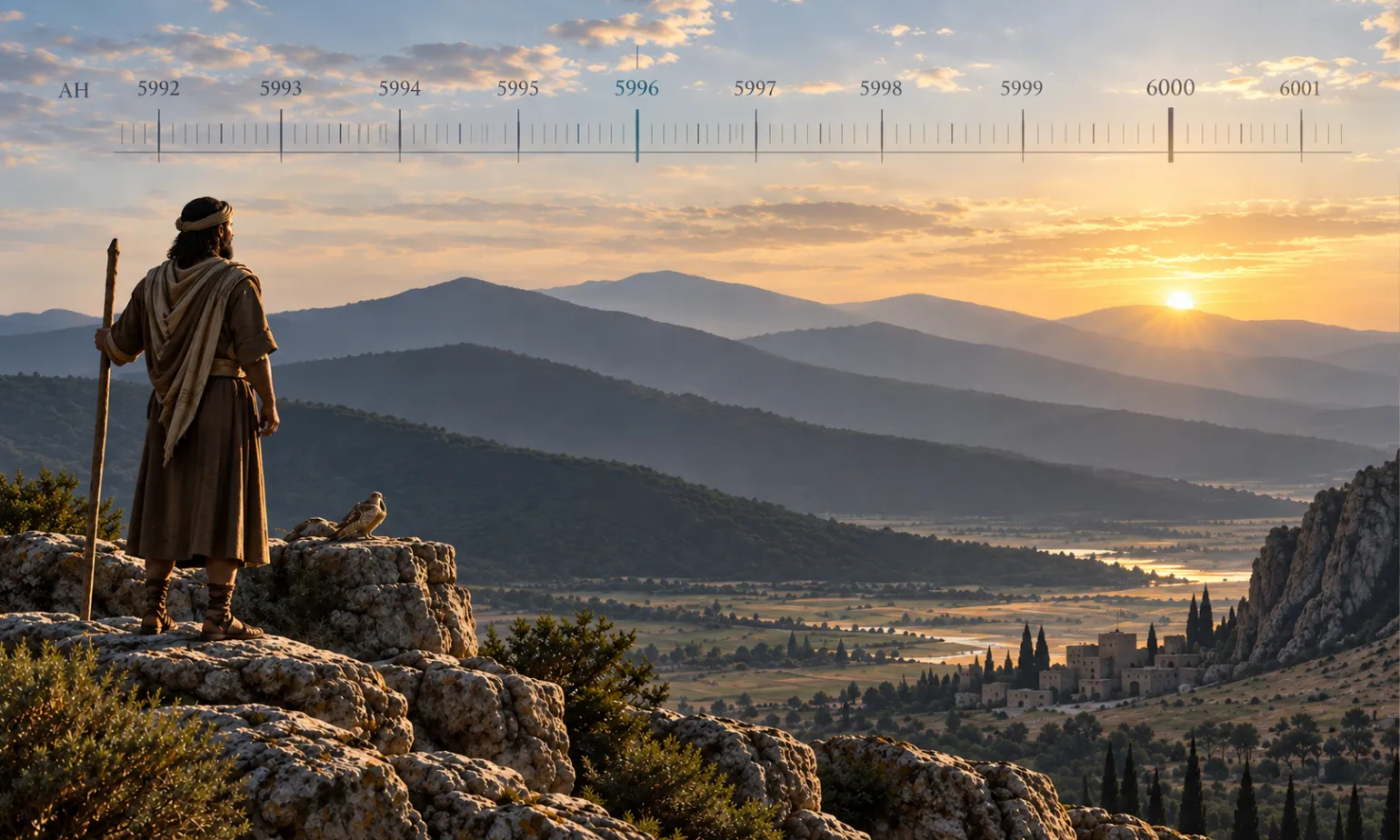
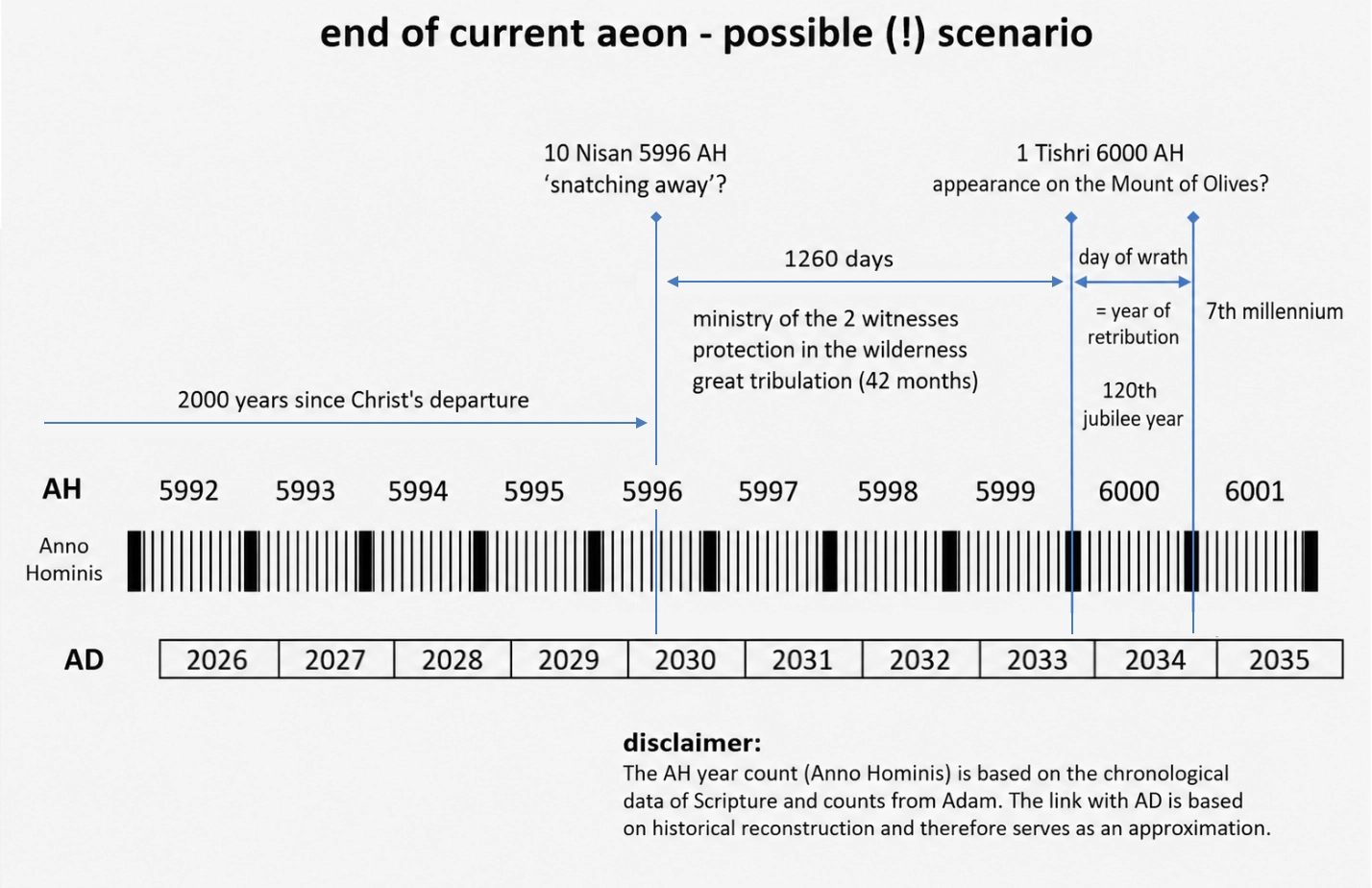
On this website, I have explained in various studies how this chronology is established. I will not repeat that argument here. My concern now is simply its remarkable consequence. If the reckoning is correct, the beginning of 5993 opens a final cycle of seven years before the year 6000 begins. Together, the years 5993 through 5999 form a complete “week of years.” Then follows the year 6000, completing the sixth millennium since Adam. At the same time, 6000 AH is the 120th jubilee year since Adam.
For clarity: by this final week of years I do not mean the seventieth week of years in Daniel 9. A “week of years” is simply a period of seven years: one complete sabbatical-year cycle. Quite “coincidentally,” we happen to be holding a conference at the end of this very month on Daniel’s seventy weeks of years! But the week of years discussed in this blog is therefore not part of Daniel’s prophecy. It is simply the final sabbatical-year cycle before 6000 AH.
six days and a Sabbath
The idea that human world history would span six thousand years, followed by a great world Sabbath, is certainly nothing new to GoedBericht (UltimateGoodNews.com). This thought has been known for many centuries, both in Jewish tradition and among early Christian writers.
In the Talmud, history is divided into six millennia, after which a Sabbath period would follow. The Jewish Encyclopedia likewise speaks of six millennia of labor followed by a “Sabbath millennium.” The Epistle of Barnabas directly connects the six days of creation with six thousand years. Irenaeus likewise wrote that, just as creation was completed in six days, everything would reach its completion after six thousand years.
Martin Luther
Even in the sixteenth century, Martin Luther aligned himself with this ancient idea. In 1540, he published his reckoning of the years of the world and stated that the year 5500 since creation had then begun. According to Luther’s chronology, the year 6000 would therefore correspond to 2040 AD. Remarkably, his calculation differs by only seven years from the GoedBericht (UltimateGoodNews.com) chronology, in which 6000 AH begins in 2033.
The basis for this interpretation is obvious. Scripture has a rhythm of six days followed by the Sabbath. Peter also writes that “one day is with the Lord as a thousand years and a thousand years as one day” (2 Peter 3:8). In Revelation 20, we then read six times of “the thousand years” during which Christ will reign and Satan will be bound. It was therefore natural for Bible interpreters throughout the centuries to understand the six days as six millennia of human history, followed by the seventh millennium: the great Sabbath day.
the first scenario
If the GoedBericht (UltimateGoodNews.com) chronology is correct, an exceptionally obvious scenario presents itself. In the year 6000, six millennia since Adam are completed. Then, in 6001 AH, the seventh millennium begins. And that seventh millennium naturally connects with the thousand years during which Christ will reign and creation will come to rest.
This does not prove that the thousand years begin exactly in 6001 AH. Scripture nowhere says so in those precise words. But if the chronology is correct and “the thousand years” of Revelation 20 are to be understood with chronological precision, this is nevertheless the first and most intuitive scenario that presents itself. Six millennia are completed, and then the seventh “day” begins.
on the eve
According to the correlation I make with our conventional calendar, 6000 AH begins in the fall of 2033. The seventh millennium would then begin a year later, in 2034. That would mean that we are now not only entering the final week of years before 6000 AH, but are also living on the eve of the great events that, according to the prophets, precede the world Sabbath: the snatching away of the Ecclesia, Israel’s great affliction, and the ensuing day of indignation. Only afterward does the great Sabbath day dawn, during which Christ will reign for a thousand years.
not a prophet
Am I uttering a prophecy by this? Certainly not. I am no prophet, but I believe the prophets, and in the light of their words I calculate and think. What I present here is not a new revelation, but an inference from Scripture. And in that inference, of course, I can be mistaken.
The correlation between the Anno Hominis chronology and our Christian calendar assumes that Jesus Christ died and rose in 30 AD. In the GoedBericht (UltimateGoodNews.com) chronology, this took place in 3996 AH, four years before the stoning of Stephen and the subsequent calling of Saul in 4000 AH. If this correlation is correct, the year 6000 AH begins in the fall of 2033. I consider 30 AD a strong and plausible starting point, but it is not directly dated by Scripture. Therefore, my baseline scenario is that 6000 AH begins in 2033/34, without thereby claiming that this is a date revealed by God.
But a qualification does not make an indication meaningless. If the reckoning is correct, the final complete week of years before the year 6000 is now beginning. After that, the sixth millennium is completed and the seventh millennium presents itself: the great Sabbath day. That is not prophecy, but it is extraordinarily striking!