 Dutch website
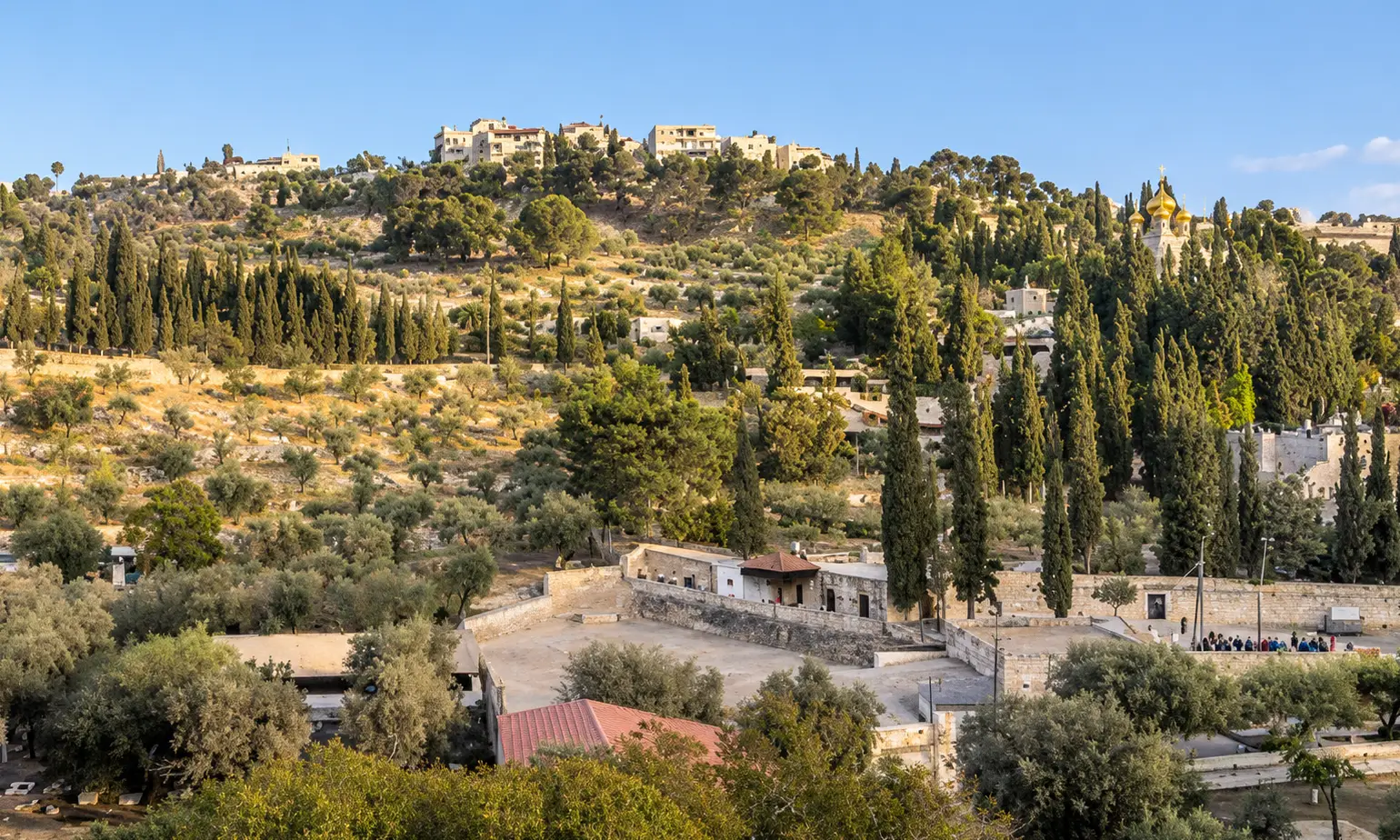
Died and Rose… on the Mount of Olives!
10-04-2004 - Posted by Geert-JanPerhaps because of the Easter season and the commotion surrounding the film The Passion of the Christ, a related issue is currently holding my attention. It concerns the location of Golgotha. It is virtually unknown, yet there are very strong biblical indications that the place called Golgotha (the Bible knows no hill called Golgotha) was located on the Mount of Olives. The key argument is as follows. We read in the Gospels that at the time of Jesus’ death, the curtain of the temple was torn from top to bottom, and that the Roman centurion saw both events happen with his own eyes. In Matthew 27:50–54 we read:
Now Jesus, again crying with a loud voice, lets out the spirit. And lo! the curtain of the temple is rent in two from above to the bottom, and the earth quaked, and the rocks are rent (…) Now the centurion and those with him who are keeping Jesus, perceiving the quake and the occurrences (literally: the OCCURRENCES*, plural)*, were tremendously afraid, saying, “Truly this was God’s Son!”
Now, only from the Mount of Olives was there a view of the magnificent temple buildings (Mark 13:3) and of the enormous curtain that hung in front of the Holy Place (note: not in front of the Holy of Holies). According to Flavius Josephus, this curtain was no less than 24 meters high (comparable to an eight-story apartment building!) and 7 meters wide! Even from a distance of, say, a kilometer, the curtain was still clearly visible. The centurion saw the curtain tear at the same moment Jesus died. And that brought him to the acknowledgment: truly, this was God’s Son.
A second weighty indication is found in John 19:20, where the translations may read, “for the place where Jesus was crucified was near the city,” but where it literally says: “near was THE PLACE of the city, where Jesus was crucified.” Since “the place” is a familiar Hebrew designation for the temple (see John 4:20; 11:48; Acts 6:13–14, etc.), Jesus was therefore crucified in the vicinity of the temple. It is well known that the crucifixion took place outside the city walls, but what is not generally known is that, according to John 19, it was near “the place.” Take a map of Jerusalem and observe that this topographical indication leads us directly to … the Mount of Olives.
Also significant in this connection is what we read in the letter to the Hebrews. Chapter 13 argues that Jesus “suffered outside the gate” (verse 12), as the fulfillment of the law concerning the sin offering, which explicitly had to be burned “outside the camp.” In the days of the successive temples in Jerusalem, this “outside the camp” was located on the eastern side of the city, on the Mount of Olives. It was also on the Mount of Olives that the sacrifice of the red heifer (Numbers 19) was offered. Various sources in the rabbinic writings leave no doubt about these facts. For Hebrew inhabitants of Jerusalem, “outside the camp” was synonymous with: on the Mount of Olives.
If Jesus was indeed crucified on the Mount of Olives, then it is clear that Jesus’ tomb was also located on this mountain. After all, the tomb in which Jesus was placed was “in the place where He was crucified” (John 19:41). But that means that the fundamental facts of salvation – the cross, burial, resurrection, ascension, and return – are all connected with the Mount of Olives! Is that not extraordinarily remarkable? The entire Evangel is anchored in what took place (and will take place; Zechariah 14:4) on “the mount called Olivet” (Acts 1:12). The main reason for this, I think, lies in the typology of the olive. Consider the following.
- The olive as a tree represents imperishable life. It is, after all, a tree that in principle does not die but regenerates itself (>rebirth). Olive trees are known that are already thousands of years old. The olive speaks of Life that is stronger than death.
- Prospective kings and priests were installed in their office by means of anointing with olive oil. Parallel to this, Jesus was appointed King and Priest “according to the power of an indissoluble life,” according to the order of Melchizedek (Hebrews 7:16–17). He holds this office on the basis of the fact that He left the tomb empty… on the Mount of Olives.
- The first sign of life after the flood was a dove with an olive branch in its beak. Here too, the olive points to life triumphing over death.
- The light that shone in the sanctuary (> heaven) was light from olive oil – “the light of life”!
- After the above considerations, it should no longer be surprising that olive oil is widely known as healthy and healing. Olive oil on wounds has a healing effect (see Luke 10:34), and in food it promotes vitality.
- Since we are talking about typology anyway, Hebrew symbolism should not be left out either. The word for olive oil is ‘sjemen’ and is related to the word for ‘eight’ (smoneh), but also to ‘heaven’ (sjamaiem). Eight is the number of a new beginning. Jesus rose “on the day after the Sabbath” (>Leviticus 23:11). Thus, after the seven (>smoneh). The Prince of Life is currently withdrawn from sight and “is seated at the right of the throne of the Majesty in the heavens” (sjamaiem).
In any case, anyone who wants to know more about Golgotha and the empty tomb on the Mount of Olives, and many more details surrounding them, I definitely recommend reading the book Secrets of Golgotha by Dr. E. L. Martin.
Share: