 Dutch website
Pierced with a lance – when?
18-05-2026 - Posted by Andre PietThis is the third, thoroughly revised version of an article previously published on March 1, 2020 and April 23, 2025.
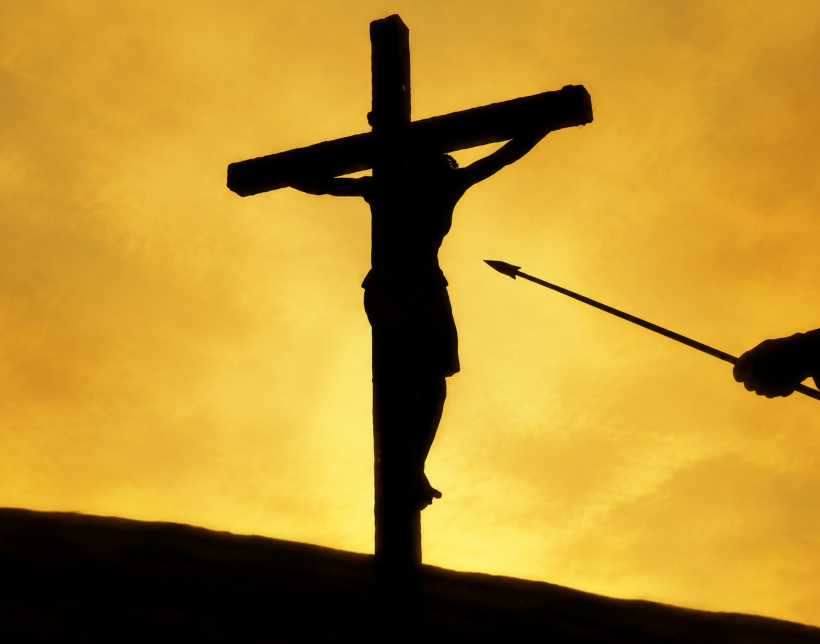
Jesus was pierced in his side with the point of a spear while he hung on the cross. This is a well-known fact. It is generally assumed that this happened after Jesus had already died. This assumption is based on the order in which John 19:32-34 is usually read:
32 The soldiers therefore came, and indeed they broke the legs of the first and of the other one who was crucified with him, 33 but when they came to Jesus, they observed that he had already died; they did not break his legs. 34 But one of the soldiers pierced his side with the point of a spear, and immediately blood and water came out.
The usual reading, then, is that the soldiers saw that Jesus had already died and therefore did not break his legs. One of them subsequently pierced his side with the point of a spear, after which blood and water immediately came out.
three questions
This reading raises several questions. Why would a soldier still pierce Jesus with a spear when it had already been established that he had died? And if there was any doubt about this, why were his legs not broken, as happened to the other two?
It is also remarkable that Jesus had died so soon. A crucifixion could last a long time. Pilate was therefore surprised that Jesus was already dead:
Now Pilate marvelled that he had already died.
-Mark 15:44-
And how are we to explain that “immediately blood and water” came out of Jesus’ side after the spear thrust? Would the blood not have flowed out more readily if his heart was still beating at that moment? And what did the “water” signify? Was it clear fluid from the space surrounding the lungs or the heart? Or could the spear have entered lower down and struck a kidney or urinary tract, so that the fluid was urine?
We do not know. The text does not tell us exactly where the spear entered or which organs were struck. We can therefore do no more than raise these questions. But what John describes fits well with a deep and fatal spear thrust.
the missing sentence
The question of when the spear thrust took place becomes even more pressing when we discover that Matthew also mentions it in the two oldest nearly complete manuscripts of the New Testament: Codex Vaticanus and Codex Sinaiticus. It is also found in several other ancient manuscripts.
The longer reading of Matthew 27:48-50 says, with the added words printed in bold:
48 And immediately one of them ran and took a sponge and filled it with sour wine and put it on a reed and gave it to him to drink. 49 But the others said, “Leave it; let us see whether Elijah comes to save him.” And another took a spear and pierced his side, and water and blood came out. 50 Now Jesus cried out again with a loud voice and gave up the spirit.
The sequence here is crystal clear. Jesus is pierced in his side, water and blood come out, he cries out with a loud voice and gives up the spirit. The spear thrust therefore does not take place after his death, but immediately before it. The spear thrust proved fatal to him.
Yet this sentence is missing from by far the majority of Bible translations.
Matthew as our starting point
Why is this sentence missing from almost all Bible translations? Not because the manuscript evidence is too weak. On the contrary. The reason is that its content presents a difficulty. Matthew places the spear thrust before Jesus’ death, whereas John is usually read as placing it afterwards. Because of this apparent contradiction, the longer reading of Matthew is set aside.
But if we take Matthew’s sequence as our starting point, John 19 can also be readily understood. When the soldiers come to Jesus, they determine that he has already died. Therefore, they do not break his legs. John then mentions the spear thrust that had preceded this and had caused blood and water to come out of his side.
In this way Matthew and John explain each other. Matthew tells us the order in which the events took place. John begins with what the soldiers later found when they came to Jesus and then mentions the spear thrust that had already taken place.
but… does it really say that?
But does John not say that the spear thrust occurred only afterwards? At first sight, that does indeed appear to be the case. The soldiers come to Jesus, see that he has already died and do not break his legs. We then read:
But one of the soldiers pierced his side with the point of a spear, and immediately blood and water came out.
Yet John does not necessarily mean that this happened only at that moment. A narrator can first tell us what someone found and then explain how that situation had arisen. John may therefore first be telling us what the soldiers observed when they came to Jesus: he had already died, and so his legs were not broken. He can then look back to what had preceded this: one of the soldiers had pierced his side with the point of a spear.
The word “but” is not a decisive objection to this reading. John does not write, “Afterwards one of the soldiers pierced…” He contrasts two actions: his legs were not broken, but his side was pierced. The word “but” marks the contrast, but does not in itself determine when the spear thrust occurred.
The Greek verb form does not rule out such a retrospective reading either. The word John uses for “pierced” is in the aorist. This verb form presents the action as a fact, but does not say that it took place after what was previously mentioned. John does not write, “Afterwards one of the soldiers pierced his side.” From the context, his statement can therefore readily be understood as: “One of the soldiers had pierced his side.”
When we read this alongside the longer reading of Matthew, such a retrospective reference becomes very understandable. Matthew gives us the sequence: the spear thrust, the outflow of water and blood, the loud cry and Jesus’ death. John begins with what the soldiers found when they came to Jesus and can then look back to the spear thrust that had preceded it.
There is then no contradiction. Matthew gives the sequence of events, while John explains why Jesus’ legs were not broken.
truly slaughtered!
The longer reading of Matthew leaves no room for misunderstanding: Jesus was pierced in his side, water and blood came out, he cried out with a loud voice and gave up the spirit. His blood flowed, and in this way he was truly slaughtered.
John expressly connects this with the Passover:
And the one who has seen it has testified, and his testimony is true, and he knows that he speaks the truth, so that you also may believe. For these things took place so that the Scripture might be fulfilled: “No bone of him shall be broken.”
-John 19:35,36-
John places every emphasis on the fact that he saw this with his own eyes. His testimony is true and he speaks the truth. As an eyewitness, he thereby confirms the report that we also find in the longer reading of Matthew: Jesus’ side was pierced and blood and water came out. But John saw more. Although Jesus was pierced and his blood flowed, not one of his bones was broken. In this John recognised the fulfilment of the Scripture concerning the Passover.
The Passover had to be slaughtered on the fourteenth day of the first month, and none of its bones were to be broken:
It shall be eaten in one house; you shall not take any of the flesh outside the house, and you shall not break any of its bones.
-Exodus 12:46-
Paul likewise expressly calls Christ the slaughtered Passover:
For indeed our Passover was slaughtered: Christ.
-1 Corinthians 5:7-
According to the longer reading of Matthew, that word takes on a very concrete meaning. Jesus’ side was pierced with a spear, water and blood came out, and he then gave up the spirit. His blood flowed, but none of his bones were broken.
The spear thrust was not a superfluous act performed on a body that had already died. According to the longer reading of Matthew, it was the manner in which Jesus died. Christ was truly slaughtered as the true Passover—and none of his bones were broken.
Share: