 Dutch website
The Passion of the Christ
24-04-2004 - Posted by Geert-JanLast night I watched Mel Gibson’s much-discussed film. By now I had heard and read so much about it that I had become intensely curious about how I myself would experience the film. Various evangelical leaders have praised the film as a biblically faithful portrayal of the final twelve hours of Jesus’ life. Well, forget it! What Gibson presents is the Roman Catholic version of the passion narrative, which is miles removed from what “is written.” There are literally dozens of examples, especially of Roman Catholic fantasies (whether or not channeled through the nun Anne Emmerich). Here is a selection, which is far from complete:
- Mary receives clean cloths from Pilate’s wife to wipe up the blood from Jesus’ scourging;
- Peter confesses his denial of Jesus to Mary (and even calls her mother!);
- Judas is pursued by children and demons and hangs himself by the carcass of a donkey (directly taken from Emmerich);
- Jesus carries a cross. Scripture uses the word ‘stauros,’ which is nothing other than a stake. Strangely enough, those crucified alongside Him in the film carry only a beam or stake;
- Jesus repeatedly falls, and the scenes we see are taken directly from the Stations of the Cross images in the Roman Catholic Church;
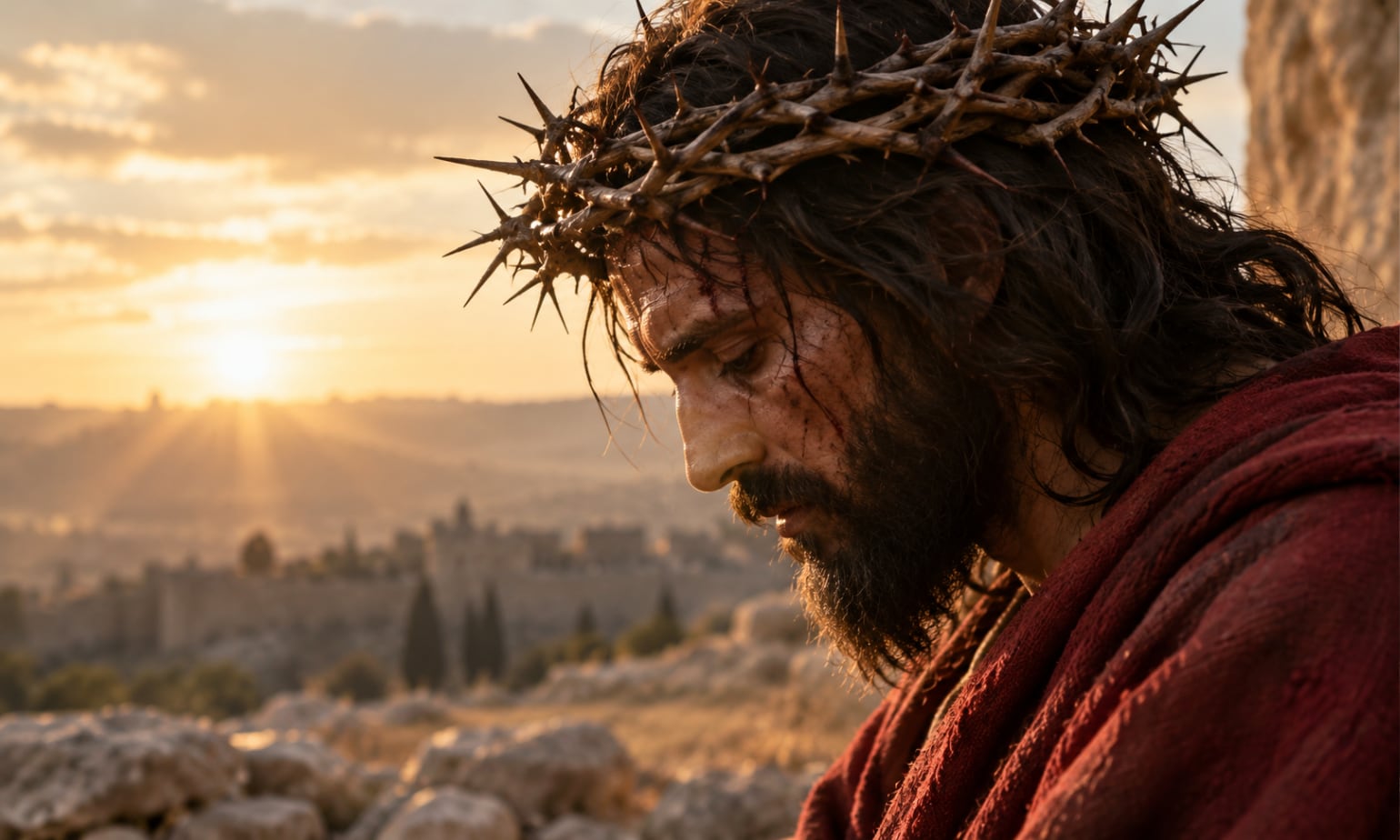
- The long-haired Jesus figure is typical of Roman Catholic imagery – Jewish men wore short hair;
- A girl wipes Jesus’ face during the journey to Golgotha – taken from the Veronica legend;
- Jesus says to one of those crucified alongside Him: “Today you will be with Me in paradise” (instead of: “Verily, to you am I saying today, with Me shall you be in paradise.”) and thereby implicitly says that Jesus did not really die;
- Mary kisses Jesus’ feet on the cross – corresponding to the Roman Catholic practice of kissing a crucifix;
- Jesus’ mother, Mary Magdalene, and John take Jesus down from the cross – the Bible mentions only Joseph of Arimathea;
- Mary holds Jesus’ dead body on her lap – a familiar image from Roman Catholic pictures.
Truly shocking is the excessive violence shown in the film. Not because the violence is portrayed too realistically, but because it goes beyond what Scripture says.
- Jesus is arrested and led away with extreme violence (chains, whippings);
- For roughly half an hour we watch Jesus being severely brutalized over His entire body in Pilate’s presence (while Mary and the Jewish leaders look on???). The soldiers in the film are unstoppable in their torture, while nothing in Scripture points to hatred on the part of the Romans toward Jesus (for them it was more of a mockery);
- Jesus is continually kicked and beaten on the way to Golgotha – Scripture says nothing about this;
- The cross dramatically falls forward – a fabrication.
In other respects as well, the film is unrealistic. I am thinking of the bandit-like way the Jewish leaders are portrayed and the almost dim-witted proceedings in the Jewish Council. The Roman soldiers, too, are often portrayed as half-imbeciles, as are the characters in Herod’s palace. It all reminds me somewhat of a farce or stage play.
Besides additions to and distortions of the biblical account, there are also troubling omissions. I mention:
- The three hours of darkness, as the ultimate low point of God-forsakenness. Instead, we see a strong wind rising.
- The Bible describes that Jesus died on the day of “the preparation” (14 Nisan), just before “the great day, that sabbath” (15 Nisan). This detail is absent from Gibson’s film.
- Instead of the curtain of the temple being torn (which we do not see), the entire temple building splits apart! And I will refrain from further commenting on the fact that the Roman centurion presumably saw the temple curtain tear from the Mount of Olives.
It should be clear by now that I consider the film anything but recommendable. Not that there was absolutely nothing good to see. That would be an exaggeration. I thought the quotation from Isaiah at the beginning was powerful. But then again, you do not need to go to the movie theater for that. The recurring view of the full moon is also beautiful. I find the depiction of the tombstone being rolled away, seen from inside the tomb, original.
But that cannot redeem my overall impression of the film. Unfortunately, just as in the Church of Rome, the focus is primarily on the dying Jesus, who supposedly achieved the victory that way. Gibson shows Satan wailing loudly in this setting. Wrongly so. For when Jesus died, the Adversary had actually made his point. Satan suffered his defeat only when Jesus left the tomb empty on the third day.
In short: the Book is infinitely better!
Additional blogposts:
Satan in ‘The Passion of the Christ’
Now Something Positive About ‘The Passion…’
Share: